Meditation & Wellness
Mindfulness Attention Trained to Meet This Moment
Mindfulness is not a relaxation technique or a philosophy. It is a specific capacity the ability to direct and sustain attention toward present experience without immediately reacting that develops through practice and produces measurable, practical changes in how a person navigates daily life.
A precise definition and why the imprecise versions cause confusion
The word "mindfulness" has been applied to so many things in contemporary culture apps, corporate wellness programs, stress management seminars, consumer products that it has become difficult to understand what it actually refers to. A working definition, drawn from both the Buddhist tradition in which the practice originated and the scientific literature that has studied it extensively: mindfulness is the deliberate direction of attention toward present-moment experience sensory, bodily, emotional, or cognitive with an attitude of non-judgmental observation.
Three elements are essential: deliberateness (attention is intentionally directed, not simply following whatever is loudest), present-moment focus (what is happening now, not memory or anticipation), and non-judgmental observation (noticing what is present without labelling it as good, bad, wanted, or unwanted). The last element is the hardest and the most transformative: it means meeting experience as it is rather than as you wish it were, which is a fundamentally different relationship to life than most people habitually maintain.
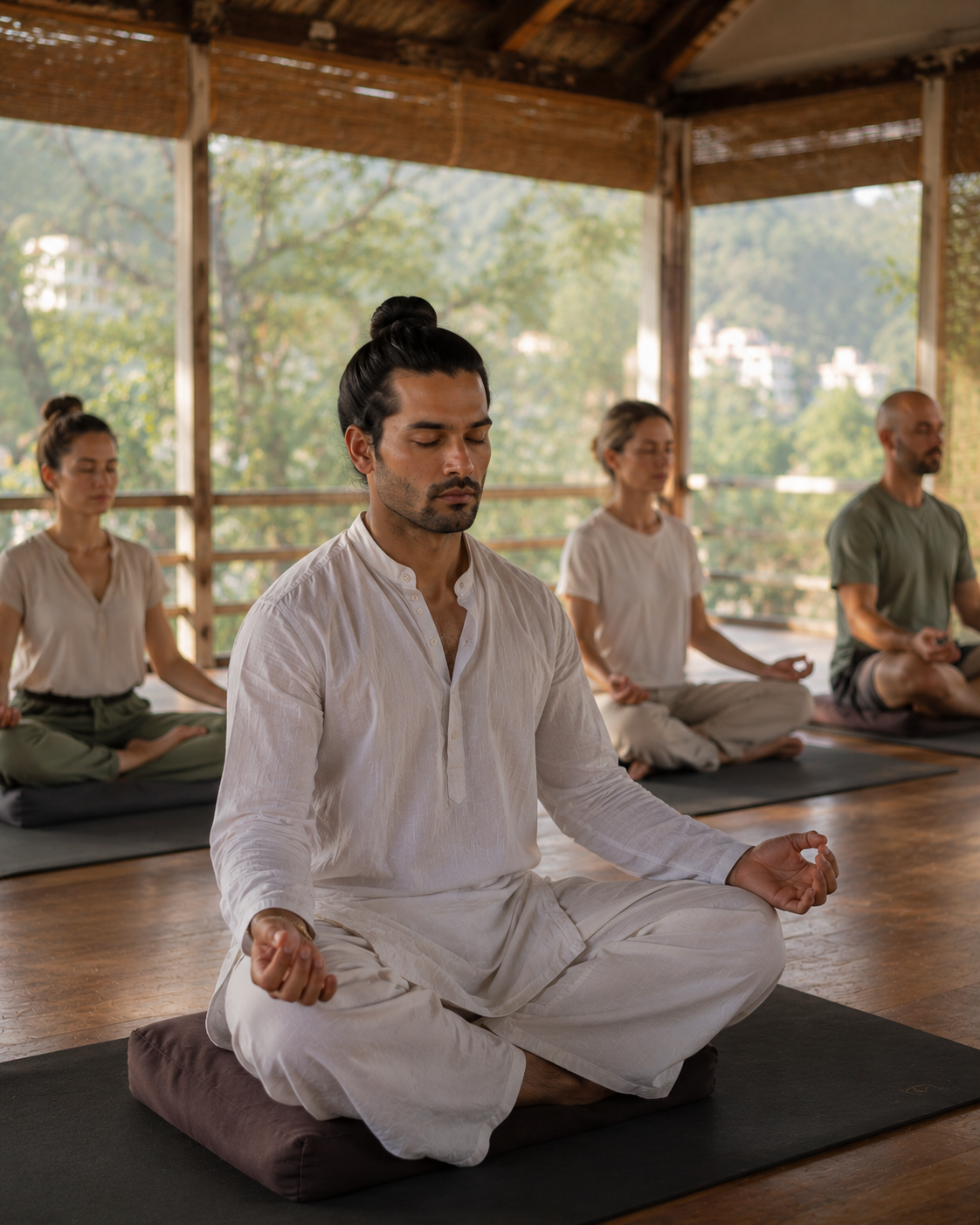
Mindfulness can be practised as formal meditation (sitting for a defined period with a specific technique) or informally as a quality of attention applied to ordinary activities eating, walking, listening, working. Both are genuine practice. The formal meditation generates the capacity; the informal application extends it into daily life where it actually matters.
In our programs, we teach both. The formal component gives students a reliable, repeatable method. The informal component gives them a way to make use of that method in the situations where it is most needed.
The specific practices taught in our mindfulness classes
Breath awareness meditation
The foundational formal practice. Sitting upright in a stable position, attention is directed to the physical sensations of breathing the feeling of air at the nostrils, the rise of the chest, the pause at the top of the inhale. When attention wanders, it is noted and returned without judgment. Practised daily for 15 to 20 minutes, this deceptively simple practice develops the attention capacity that underlies all other mindfulness applications. It is both the entry-level and the lifetime practice.
Body scan meditation
Lying down, attention moves systematically through the body from feet to crown (or crown to feet), dwelling briefly in each area and simply noticing whatever sensation is present warmth, coolness, tingling, pressure, numbness, or no sensation at all without trying to change it. The body scan develops somatic awareness (the ability to feel the body from the inside), often reveals areas of holding that were previously unconscious, and teaches the foundational mindfulness skill of meeting experience as it is rather than as you wish it were.
Mindful movement
Yoga or slow walking practised with full sensory and proprioceptive attention aware of each movement from the inside as it occurs, aware of the breath as it accompanies each transition, aware of where attention goes and repeatedly returning it to direct physical experience. Mindful yoga in this sense is distinct from yoga-as-exercise: the intention is not to achieve postures but to develop the quality of attention that postures can support when approached this way. This is the bridge between formal sitting practice and the informal application of mindfulness in daily physical activity.
Open monitoring / choiceless awareness
A more advanced formal practice in which the meditator rests in bare awareness itself aware of whatever arises (thoughts, sounds, sensations, emotions) without selecting or suppressing any of it. Unlike focused attention practices that use a single object as anchor, open monitoring invites everything that arises to be held equally without preference. This practice is typically introduced after students have established concentration through breath or body-based practices, as it requires a degree of stability that earlier practices develop.
STOP practice
A brief informal practice from the MBSR (Mindfulness-Based Stress Reduction) tradition: Stop (pause), Take a breath, Observe (what are you feeling, thinking, sensing right now?), Proceed. Used as an interruption of automatic reactive behaviour during daily life before sending an email written in anger, before responding to a challenging situation, before making a difficult decision. The STOP practice is not meditation but an application of mindfulness capacity in real time. It takes ten seconds. Its practical value is disproportionate to its brevity.
Loving-kindness (Metta)
A mindfulness practice with an explicitly emotional focus directing phrases of goodwill ("May you be well, may you be happy, may you be free from suffering") first toward oneself, then toward others in expanding circles. Metta develops the quality of affectionate attention that prevents mindfulness from becoming cold or clinical. Research consistently shows Metta practice produces increased compassion for self and others, reduced implicit bias, and changes in activation patterns in the areas of the brain associated with empathy and social cognition.
Mindfulness does not make you feel better in the sense of feeling more comfortable. It makes you better at feeling more able to be present with difficulty without being destroyed by it, and more able to be present with joy without grasping at it.
This is a practical, achievable capacity. It develops through practice. It matters more than most of what we pursue in the name of wellbeing.
The contexts in which mindfulness practice produces the clearest results
Professionals under sustained cognitive demand
Doctors, lawyers, teachers, engineers, writers, researchers, and others whose work requires sustained concentration and frequent complex decision-making report consistent improvements in the quality of their work attention, reduction of mental fatigue, and improved capacity to think clearly under pressure after establishing a regular mindfulness practice. The attention-training mechanism applies directly to any domain requiring focused cognitive work.
People in high-stress environments
Stress does not produce its most damaging effects during the stressful event itself it produces them through the anticipatory anxiety, rumination, and prolonged physiological arousal that persists after the event. Mindfulness practice specifically targets these patterns: reducing rumination by making thought itself an object of observation rather than an automatic process, and reducing anticipatory anxiety by training the mind to remain present rather than inhabit imagined futures.
Anyone wanting to live more fully in their actual life
The most universal benefit of mindfulness practice is simply this: the proportion of one's life that is actually lived, rather than mentally absent planning, reviewing, worrying, imagining gradually increases. Students who practise consistently report noticing more of what is actually happening around them: conversations become more genuinely heard, meals more genuinely tasted, relationships more fully present to. This is not a dramatic transformation. It is a quiet, cumulative shift in the quality of ordinary experience.
Interested in mindfulness practices?
Tell us what you are looking for personal practice development, corporate training, or something specific.
What pairs naturally with mindfulness training
Explore All Programs & Services
Quickly select any service below to explore schedules, curriculum, and direct WhatsApp booking.
Develop a mindfulness practice with clear instruction and honest support.
Tell us your experience level and what you are hoping to develop. We will recommend the right starting approach.